Ink Before Interface: The Quiet Return of Analog Thinking in American Architecture
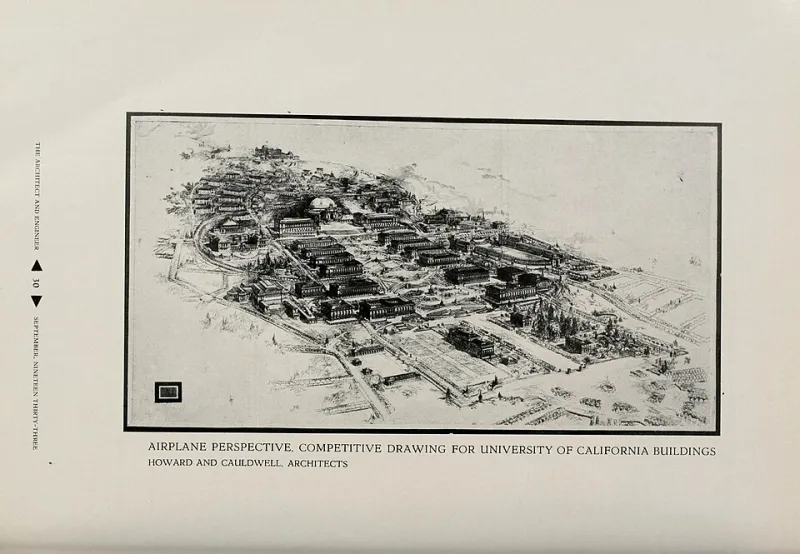
Photo: Internet Archive Book Images, No restrictions, via Wikimedia Commons
There is a particular silence in a studio when someone is drawing by hand. No keyboard percussion, no cursor blinking at the edge of a viewport—only the faint friction of graphite against paper. Walk through C.J. Lim Studio 8 on a working morning and you will hear it. It is not nostalgia. It is method.
Across the United States, from Chicago's historic drafting rooms to young practices in Los Angeles and Portland, architects are quietly re-embracing the oldest technology in the discipline: the drawn line. This is not a rejection of Building Information Modeling or computational design—both remain essential to how buildings are documented, coordinated, and constructed. Rather, it is a recognition that the tools of documentation are not the tools of invention.
The Difference Between Recording and Imagining
Software, for all its precision, tends to ask the designer to decide too early. A wall drawn in a model is already a wall—dimensioned, materialized, committed. A line drawn by hand can still be a wall, a shadow, a grove of trees, or the edge of a thought. That ambiguity is not a weakness. It is where architecture happens.
Neuroscientists who study spatial cognition have long observed that drawing activates reasoning pathways distinct from those engaged by screen-based manipulation. The hand slows the mind to the speed of consideration. When an architect sketches a section freehand, the act of drawing forces a confrontation with proportion, light, and structure that a rendered model can obscure behind its own polish.
This is why, at Studio 8, every project—regardless of its eventual digital workflow—begins on paper. The drawings are not preliminary. They are foundational.
A Tradition With Deep American Roots
The resurgence is less a revolution than a return. Louis Kahn's luminous charcoal studies, the travel sketches of Lebbeus Woods, the visionary watercolors of the paper architects whose unbuilt ideas reshaped American discourse—these works are studied not as artifacts but as arguments. They demonstrate that a drawing can carry an idea further than a specification.
Contemporary American firms have taken notice. Design juries at leading universities increasingly ask for process sketches alongside digital deliverables. Competitions for public projects in cities like New York and San Francisco often hinge on presentation boards whose persuasive power comes from the evident hand of the author. Clients, it turns out, respond to the humanity of the mark: a hand drawing signals that a person imagined this place, and stands behind it.
Why Clients Are Paying Attention
There is a trust economy at work. When a prospective client receives a photorealistic render, they receive an image of an outcome. When they receive a hand drawing, they receive an invitation—an image of an intention, legible in its optimism and its openness. The visible stroke says: this is a proposal, and you are welcome into its making.
For civic projects especially, this matters. Public review boards respond to drawings that feel discussable rather than decreed. The looseness of the line licenses conversation.
Neither Nostalgia nor Luddism
It would be easy to caricature this movement as anti-technology. It is the opposite. The most compelling American practices operate bilingually—sketching to think, modeling to resolve, drawing by hand to communicate. The pencil and the processor are not rivals; they occupy different moments in the life of an idea.
What the revival insists upon is sequence. Imagine first, in the medium most hospitable to imagination. Document later, in the medium most suited to certainty. Studios that invert this order—beginning in the model, sketching only to decorate—tend to produce buildings that are accurate and inert.
The Line as Legacy
Architecture's great unbuilt works survive as drawings. The built works, too, are remembered through them—the charcoal Kahn, the red ink of an early master plan. In an era when renders can be generated by the thousand, the singular, imperfect, authored drawing becomes only more valuable: proof of a mind at work.
That is the conviction behind every sheet that leaves this studio. The hand-drawn line is not a stylistic preference. It is a claim about what architecture is: a human act of vision, drawn before it is built.