Graphite, Gum, and Grain: A Working Inventory of the Studio 8 Desk
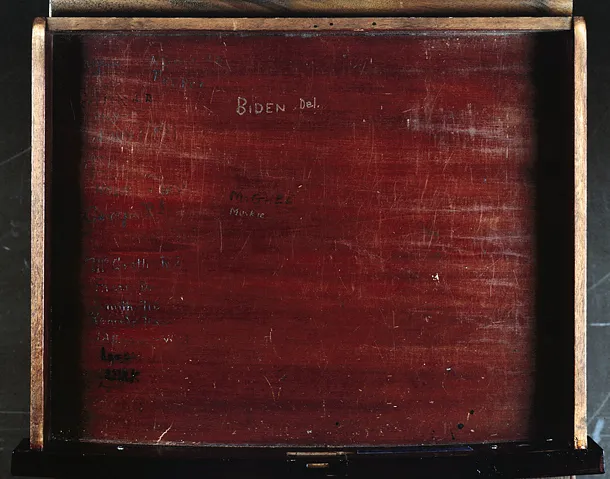
Photo: Architect of the Capitol, Public domain, via Wikimedia Commons
Visitors to the studio sometimes assume that the drawings on our walls — the section studies, the travel sketches, the dense little plans that precede every commission — are the product of sentiment. They are not. They are the product of habit, and habit in this office begins with a short list of objects that have changed very little in two decades.
What follows is not a endorsement of nostalgia. It is an argument, quietly made, that the material conditions of the desk shape the decisions that eventually reach the site. A pencil that resists easily produces buildings that yield too quickly. Paper that forgives everything produces architects who question nothing.
The Paper Decides the Patience
We draw on heavyweight papers with visible tooth — a cold-press watercolor stock for the large study sheets, and a simpler cartridge paper for the everyday plan. The texture matters. On a slick sheet, a line slides; on a toothy one, a line must be meant. The friction between graphite and grain is a small, constant audit of intention.
American stationery shops still stock excellent options: the Legion Stonehenge pads carried by most Blick stores, or the Strathmore 400 series found in nearly every art supplier between Portland and Providence. We buy by the ream, because a sheet should never be precious. Precious paper produces timid drawings, and timid drawings produce cautious buildings.
Three Pencils, No More
The studio keeps a deliberately narrow range: a 2H for the faint scaffolding of a plan, an HB for the working line, and a 2B for the emphatic marks — a shadow, a section cut, the single stroke that ends a debate. Anything softer smears under the tracing paper we layer over everything; anything harder reads as hesitation.
We favor wooden pencils over mechanical ones, and not for romance. A wooden pencil changes as it is used. It sharpens to a point, dulls to a chisel, and the draftsman unconsciously adjusts — broad strokes for tone, fine ones for dimension. The tool teaches rhythm the way a good site teaches restraint.
The Eraser Is a Design Instrument
Colleagues sometimes joke that our erasers are the most senior members of staff. We use soft white vinyl erasers for the general revision and, for the surgical work, a kneaded eraser shaped to a point — capable of lifting a single line from a crowd of fifty without disturbing its neighbors.
This is not tidiness. It is a method of thinking. To erase well, one must first understand why a line fails, and that question — asked a hundred times a day at the desk — is the same question asked later on site when a wall meets a tree it should have avoided. The eraser trains the judgment. The gum and the kneaded simply keep the receipt.
A Starter Kit for Drawing Along
For readers who have written to ask how to begin sketching buildings — and the letters arrive weekly, for which we are grateful — the list is short:
- Paper: A cold-press or cartridge pad, 90 lb or heavier. The Strathmore 400 series is a reliable American standard.
- Pencils: One 2H, one HB, one 2B. Wooden, not mechanical.
- Eraser: A white vinyl block and a kneaded eraser. Both, always.
- A roll of tracing paper: For overlaying revisions without destroying the record.
- A folding stool and a clipboard: Because the best drawings of American ground are made standing on it.
The total cost is modest — less than a good dinner in most American cities — and the return, over a lifetime, is considerable.
Why Any of This Matters to a Client
A client reading this may reasonably ask what their fee has to do with our pencil inventory. The answer is accountability. Hand drawing is slow, and slowness is a form of quality control. Every line at the desk has passed through a hand that felt the tooth of the paper and the resistance of the graphite, and hesitated — however briefly — before committing.
We do not believe the computer has ruined architecture; our own documentation is digital, as it must be. But the decisions worth making are made here, in graphite and gum, before they are worth rendering. The stationery is not a style. It is a discipline — and, like the buildings we hope to leave behind, it is chosen to last.