Before the Plan, the Storm: Studio 8's Hand-Drawn Almanac of a Building's First Year
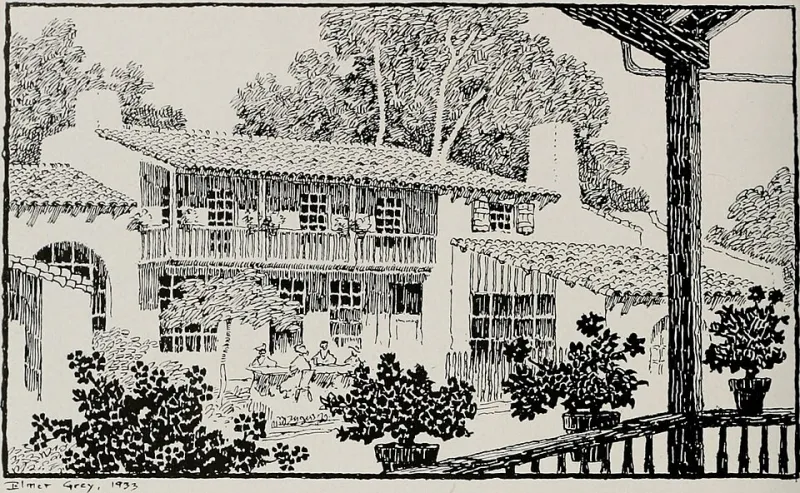
Photo: Internet Archive Book Images, No restrictions, via Wikimedia Commons
Every commission at Studio 8 begins the same way, and almost never with a plan. It begins with a sheet of paper on which we draw the weather.
Not a sun-path diagram, not a wind rose pulled from a weather database, but a drawn, narrated, shaded account of what the first twelve months at a site will likely feel like: the April cloudburst sheeting off a proposed roofline, the August breeze threading through a courtyard, the February drift piling against a parapet in Chicago. We call these sheets our almanacs, and they precede every plan, section, and model we produce.
The practice surprises clients. It has also, over the years, saved them.
Drawing What the Software Renders Away
Contemporary rendering has a peculiar relationship with weather: it eliminates it. Digital visualizations favor the perpetual golden hour — cloudless skies, windless afternoons, a population of pedestrians dressed for no particular season. The result is a portrait of a building that will exist for roughly forty minutes a year.
A drawn storm is different. The pencil cannot flatter. When we sketch rain hugging the eaves of a proposed Texas pavilion, the drawing tells us whether the covered porch will actually shelter anyone or merely redirect water onto the threshold. When we shade the shadow of a proposed tower across a Minneapolis residential street in January, the graphite does not negotiate. It simply records where the sun will not go.
This is why we consider hand-drawn weather the most honest site survey available to the American architect. Soil reports and drone surveys tell us what the ground is. A drawn almanac tells us what the ground will do.
Three Sheets That Changed Three Buildings
The almanac is not ceremonial; it alters design decisions routinely.
For a civic library in the Pacific Northwest, our first sheet depicted a November gale moving across the proposed entry plaza. The drawing revealed that the intended windbreak — a low garden wall — would funnel gusts directly at the door instead of deflecting them. The wall was rebuilt in plan as a staggered baffle, and the entrance, once a wind tunnel, became a place where people linger.
For a courtyard house in the Mountain West, a drawn winter sequence showed snow sliding from a metal roof onto the primary walking path. The solution was unglamorous — a relocated path, extended snow guards — but it arrived before construction, when a change costs pencil lead rather than poured concrete.
And for a rooftop terrace in Chicago, the almanac's January sheet, all hatched wind arrows and drifted snow against the parapet, persuaded the client to move the gathering space inward and let the exposed edge become a garden. The terrace now performs in July and looks composed in February.
An American Practice, Born of American Weather
There is a reason this discipline feels particularly urgent here. The continental United States stages more weather than almost any comparably sized territory: hurricane surge along the Gulf, derecho winds across the Plains, atmospheric rivers in California, lake-effect snow, tornado alleys, ice storms. American buildings have always been negotiating with an unreasonable sky.
Yet our profession increasingly designs as if climate were a compliance exercise — a load calculation, a resilience checklist. The almanac restores climate to its older role: a collaborator with a temperament. To draw a building's first year is to admit, on paper, that the building will be rained on, baked, frozen, and shaken. That admission, made early and by hand, tends to produce humbler and better structures.
It also produces better conversations with clients. A rendering invites approval. A drawn storm invites a story — the client remembers the hailstorm that damaged their childhood home, the summer the street flooded. Weather is the one subject on which every American is an expert witness.
What the Almanac Contains
Our sheets follow a loose convention, refined over two decades:
- Twelve vignettes, one per month, drawn in whatever the site's dominant condition happens to be — fog, glare, thaw, drought.
- A water sheet, tracing a single raindrop from sky to roof to gutter to grade, exposing every place the design interrupts or insults its journey.
- A wind sheet, in which arrows are drawn at the speed we estimate, not the speed we hope.
- A failure sheet — the most important — imagining the design in the worst year on record, not the average one.
The failure sheet is where our clients initially flinch and eventually lean in. It is not pessimism. It is the architectural equivalent of an umbrella: cheap, unglamorous, and grateful for it later.
Ink Against the Unpredictable
We do not pretend a drawing can outsmart a changing climate. Storms are growing less predictable, and no almanac, however careful, guarantees foresight. But that is precisely the argument for drawing weather rather than simulating it. A simulation implies certainty we do not possess. A drawing admits its author — a person, watching, worrying, sketching what they cannot control.
In an era when the American forecast has become a matter of consequence, humility is a design tool. We draw the storm before the plan because the storm, unlike the plan, is not ours to revise.
The paper holds the weather so the building doesn't have to.